

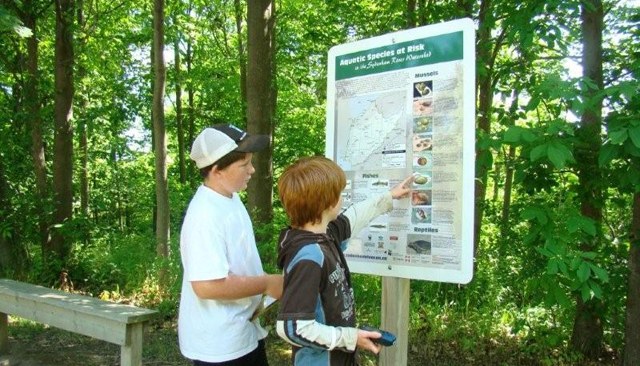
Outdoor education brings classroom studies to life. The St. Clair Region Conservation Authority (SCRCA) is excited to welcome students to the Lorne C. Henderson Conservation Area for traditional in-person field trips during the 2025-2026 school year. Most programs are 2 hours in length. Field trips are also available in French – Disponible en français.
Endangered Species Game (Grades 4–6)
Available anytime! September-June
This active game introduces students to some of the Species at Risk found in Ontario. Students role-play ‘special concern’, ‘threatened’, and ‘endangered species trying to survive the many threats affecting local wildlife. Student success decides which species go extinct and which expand their populations, and thereby change their ‘at risk’ status.
Pokecaching (Grades 4–8)
Available anytime! September-June
Pokecaching is a “Pokemon Go” inspired geocaching game designed by LKDSB Enrichment Students that puts the Geography curriculum into action. Participating students will use GPS units to locate Pokecaches. Tokens will be collected for a “Pokemon Gym Battle” at the conclusion of this 2-hour program.
Instincts for Survival (Grades 4–8)
Available anytime! September-June
‘Survival of the fittest’ is nature’s law that assists the balance of nature This simulation game teaches students about species inter-dependencies, predator/prey relationships, survival adaptations and tactics, and natural and human impacts on wildlife.
Geocaching (Grades 5–8)
Available anytime! September-June
Geocaching is a high-tech treasure hunt using a Global Positioning System (GPS) receiver along with Latitude and Longitude coordinates to find hidden caches. Students will learn how to ‘mark’ waypoints, ‘hide’ a cache, and ‘find’ hidden geocaches in the Conservation Area.
A Bug’s World (Grades 6)
Available September-November and April-June
Identification and Classification are easy concepts to understand when we look at insects and other invertebrates found in the Conservation Area. This program explores the biodiversity found in two habitats – the pond and the forest. Students learn basic classification techniques and then apply them to real-life ‘bugs’ during this field experiment!
Wild Wild Wetlands (Grades 7–8)
Available September-November and April-June
Students explore a wetland ecosystem during this field study! Observing the plants and animals found in a wetland can tell a scientist a lot about the health of that ecosystem. Students are introduced to water quality and during the program will complete a benthic bio-indicator study, which will help determine the quality of water in the pond at the Conservation Area.