

This year, St. Clair Region Conservation Authority was awarded funding from the Ministry of the Environment, Conservation, and Parks (MECP) through the Wetland Conservation Partner Program (WCPP) to help enhance and restore wetlands in the St. Clair Region.
SCRCA staff have allocated the funds to implement wetland, upland, and riparian buffer habitat on private landowner property; completed invasive species management on multiple landowner properties, along road allowances, as well as at the Keith McLean and Bates Conservation Areas.
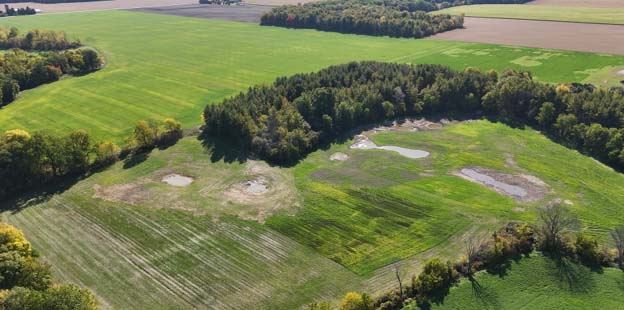
One of the habitat projects that was funded in part through WCPP involved excavating a 1.6-acre shallow wetland complex in a farm field in Florence (Figure 1). This project is part of a larger, phased land retirement project initiated by the landowners. The landowners currently have nearly 13 acres in treed and naturalized habitat on their property. Next year, the project will grow to include a nearly 11-acre tree planting project. The landowners wish to expand the existing natural habitat on their land to provide food and shelter habitat for local wildlife and reduce sediment and nutrient runoff to the municipal drain, adjacent to the field.
“Wetlands are some of Ontario’s most vital natural infrastructure, helping to protect our communities from flooding, filter the water we drink and provide habitat for countless species,” said Todd McCarthy, Minister of the Environment, Conservation and Parks. “Through the Wetland Conservation Partner Program, our government is proud to support the St. Clair Region Conservation Authority and local landowners in their work to safeguard our natural heritage for generations to come.”
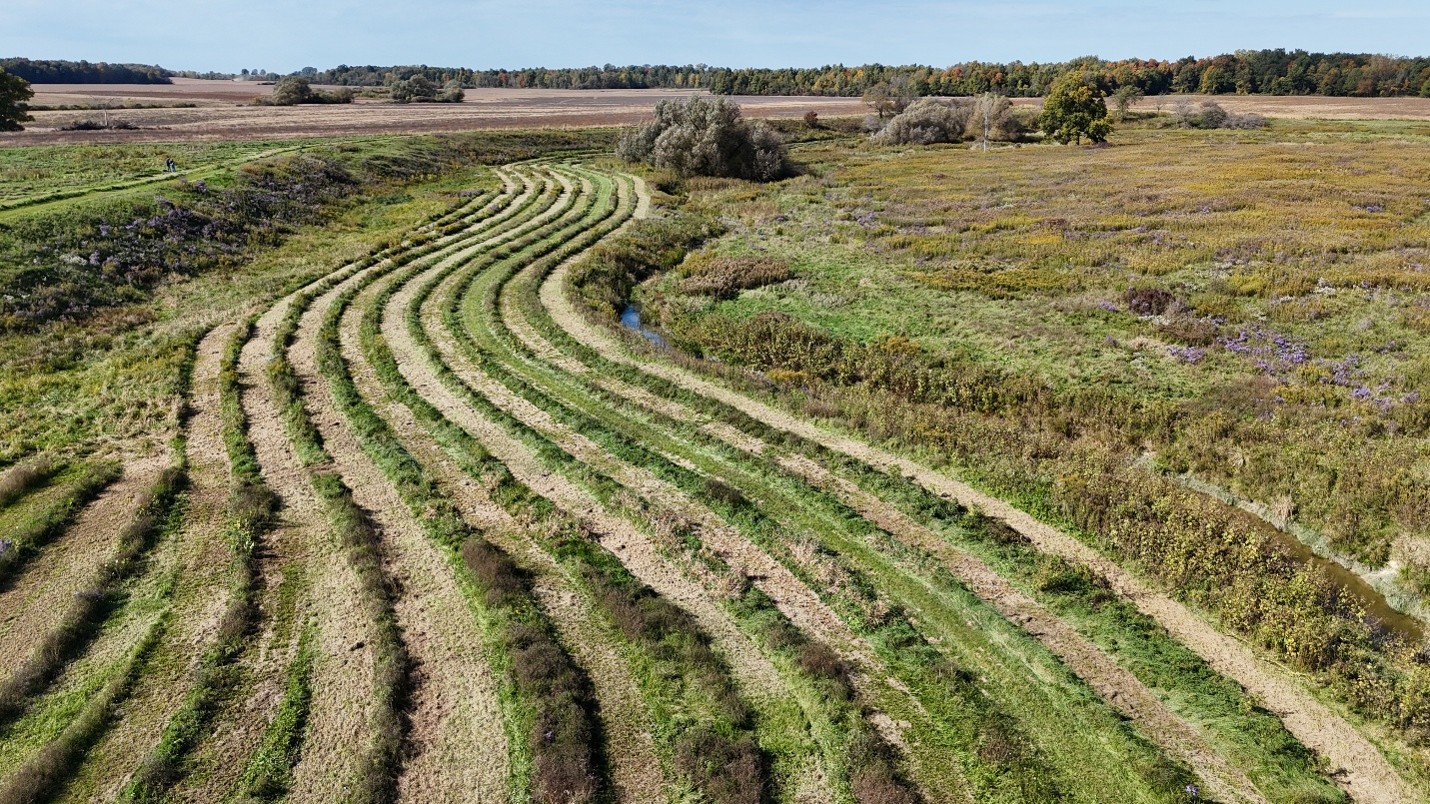
Funding from WCPP also contributed to a key riparian and upland tree and shrub project in a retired cow pasture (Figure 2). This 13.6-acre riparian buffer project saw 10,700 native trees and shrubs planted. This project will provide wildlife habitat in addition to mitigating water quality impacts in the adjacent watercourse. According to the family, this project was especially important because “it will provide a protective environment for vulnerable species of birds, reptiles and insects, while offering a unique and special natural space that can be enjoyed by the family for generations to come”.
Rapidly expanding populations of invasive Phragmites australis, or as it is more commonly called, “Phrag”, interrupt wetland ecosystem balance as they establish monoculture stands in semi-wet and wet environments outcompeting our Ontario native wetland species that provide food and shelter habitats for a multitude of aquatic organisms including migrating waterfowl and reptiles and amphibians and impeding the views for nature enthusiasts on trails and natural lands. Phragmites are prolific invaders, spreading via both seed and rhizome. Phragmites also have social and economic impacts, including burdening municipalities with increased maintenance costs of removing Phragmites stands that clog roadside ditches and reduce sightlines.
Partnering with Lambton County, local municipalities, and landowners, SCRCA has developed a mapping protocol to outline all herbicide-treated Phragmites stands in our region on an annual basis. To date, SCRCA Conservation Services staff have developed and executed 26 new Phragmites management plans and re-treated 27 areas for private landowners and 5 plans for municipal and corporate partners. Collaboration is key in mitigating impacts of Phragmites in Lambton County.
SCRCA also utilized WCPP funds to map and develop an invasive species management plan at the Keith McLean and Bates Conservation Areas. Phragmites¸ amongst other invasive aquatic vegetation, has been impeding the wetland habitats on these properties. To date, SCRCA has mapped and digitized nearly all of the wetlands and invasive plants on both properties and have drafted a management plan. Much of the Phragmites on the properties has been treated and will be cut down later this fall. Kelli Smith, Conservation Land Biologist states, “this mapping project allows us to quantify the impact the invasive species have on the properties and further helps us to compare the effectiveness of treatment over time”.
If you are interested in restoring wetland or upland habitat on your rural property, please contact Jessica Van Zwol [email protected] (519-245-3710 x241) for more wetland project information or Jeff Sharp [email protected] (x217) for more tree planting information.